


A Portrait of Strength, Grace, and Legacy
Premila Kollipara
Some interviews educate you, some interviews inspire you, and then some conversations quietly rearrange something inside you.
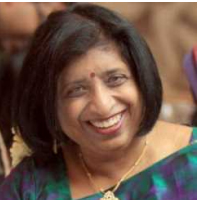
Dr Premila Kollipara speaks with the soft confidence of someone who has held thousands of hands through life’s most fragile moments. She laughs with a disarming lightness that makes even the heaviest stories feel bearable. Peeking behind the humility is the sharp, unmistakable intellect of a clinician who has mastered her craft. Woven through it all is a quiet strength — the kind that comes from a lifetime of showing up, day after day, with compassion and unshakeable discipline.
Wrapped in her effortlessly graceful saree, she smiles, and suddenly you feel as if you’re sitting with someone who has not only lived history, but shaped it in small, steady ways. What unfolded was not just an interview, but a rare invitation into her life.
INTRODUCING Dr. KOLLIPARA
Dr Premila Kollipara is a consultant Gynaecologist at Barking, Havering, and Redbridge University Hospitals NHS Trust. She has thriving practices at both Spire Hartswood private hospital in Brentwood and Spire London East private hospital in Redbridge, and specializes in early pregnancy problems and vaginal surgery. She was the best outgoing student, a John Stone Gold Medalist. She received the President of India Gold Medal for the best medical student at Madras Medical College during her undergraduate studies. A gold medalist in her postgraduate studies at the Institute of Obstetrics & Gynecology, Dr Kollipara is an athlete, active sportswoman, and passionate teacher, having been awarded the Top Teacher Award for three consecutive years by University College London. She speaks seven languages — which, she assures me, “is nothing unusual.”
A WALK DOWN MEMORY LANE
When I ask Dr Kollipara about her childhood, something softens in her expression — a quiet warmth that settles into the room. She speaks gently, but with unmistakable clarity.
“Family and school… those two shaped everything.”
She grew up in a home where excellence wasn’t demanded so much as naturally nurtured. With two daughters, her father invested deeply in their education — but with one simple condition:
“Do well in whatever you choose.”
She recalls his passion for cricket with a fondness that lights her face:
“I’ve been to every cricket match in Chennai since I was five or six. I saw Wes Hall bowling in Chennai!”
Her school, Church Park, shaped both her athletic and academic identity. A sprinter in the 100m and 200m, she finished as the best outgoing athlete of her year. But it was the values that stayed with her:
“They taught us fantastic values. And even though it was a Catholic school, we were not pushed into Catholicism. We were taught morality, discipline, and kindness. Science was important. Being good was important.”
Her multilingual fluency has an origin only she could recount with such understated charm:
“I learned Tamil by reading cinema posters outside school.”
Her laugh — brief and bright — fills the air. Malayalam and Telugu came from teachers at home, Hindi at school, French by strategy (“because it was easier to score distinctions than Hindi,” she says with a grin), and Arabic much later in Saudi Arabia.
When she recalls the moment her journey into medicine crystallised, her tone shifts, and she speaks of the tragedy that shaped her path: her mother’s younger sister died of a massive obstetric haemorrhage in Kolkata during her second pregnancy, and her cousin came to live with them. Childhood grief quietly redirected itself into purpose.
“How could such a young person die? That question stayed with me. I think that pushed me into medicine, and into obstetrics and gynaecology.”
THE RED FORT TALES
This section amuses her before she even begins.
“Ah, yes, Red Fort! That’s where we had our anatomy dissections, and every day we walked across to the canteen, past all the naughty boys under the trees making remarks!” she recalls. “We would walk very fast, pretending we didn’t hear anything.”
But she brightens when she remembers the academics, her eyes shining with gratitude.
“Professor Cooper taught anatomy so beautifully. And in physiology, Dr Krishna Swami and Dr Jana are truly excellent teachers. The giants of clinical medicine at MMC — Dr Sandanathan, Dr Annanmalai, Dr Sam G P Moses, Dr Ramakrishnan, Dr MS Prakash.” Then she says the one line that lingers long after the conversation ends:
“Every step of the way, someone excellent taught us. If you were interested, they taught you even more.”
She walks me through the MMC-to-IOG journey with the reverence of someone who rose to mastery without ever forgetting who shaped her.
When asked about her early training days as a house surgeon, with a mischievous glint, she sums it up in one breath:
“The boys never did much, you know… they would go to the Ashoka Hotel for breakfast, lunch, dinner. We girls would do all the work — but we didn’t mind, because we got more chances to do Caesareans, more chances to operate.”
Behind the humour lies the truth of her ascent: she became outstanding because she worked relentlessly — day after day and case after case.
When asked about choosing a specialty, she recalls the moment her path shifted.
“I wanted to be a general surgeon. But my teachers said — ‘As a woman, patients may not come to you. Do obs and gynae. You can operate there too.’ So that’s what I did.
She offers it plainly, allowing the moment’s simplicity to carry its own weight.
THE RESIDENCY YEARS: A TRUE CHALLENGE
When she speaks about her residency at the Institute of Obstetrics & Gynaecology, her voice settles into a steady calm. The numbers themselves tell the story of an era that demanded endurance:
24,000 deliveries a year.
Three uninterrupted months on the labour ward.
No weekends.
No breaks.
Day shifts of 8 am–8 pm.
Night shifts of 8 pm–8 am.
“It gave us continuity. It made us capable. You learned to manage everything — because you had to.”
She recalls performing spinal anaesthesia herself, turning the patient, and completing the caesarean section with quiet efficiency.
“We learned to be quick surgeons… before the spinal wore off.”
She says it without emphasis, as someone who absorbed the skill long before she learned to describe it.
The case she will never forget
Her tone softens.
“One woman came to us… after an illegal abortion. And when I examined her, the entire small bowel was hanging out of her vagina.”
A brief pause.
“It was a shock. But we had to act. Sepsis. Emergency. Those experiences — they shape you.”
THE CAREER ARC
Her early career was anything but linear. After her MD, she joined the ESI Hospital through the Tamil Nadu Public Service Commission. She pauses, then smiles as she tells me:
“I had only one ambition — to become the Director of the IOG. That was my dream.”
Her own pregnancy led her to teaching physiology at MMC. She then moved to RSRM as Assistant Professor, each step bringing her closer to the institution she had hoped to return to.
In time, she reached IOG. But six months into her posting, tragedy struck. A staff nurse accidentally administered a corrosive agent instead of medication to a pregnant women, pouring it down their throats (as was the practice to give medication back then). Three women died.
“That was my ward. I wasn’t on duty, but they were my patients. It was terrible.”
Even decades later, the memory sits close to the surface.
She continued teaching and operating, built her private practice, raised her children, and later worked across Saudi Arabia and the UK — carrying the same steady discipline she had learned in Chennai.
Her sari never changed.
Her values never shifted.
And her work ethic never dimmed.
Her philosophy is simple, and she doesn’t dress it up:
“Hard work is the only way. That is all I have ever known.”
She adapted to Saudi Arabia by learning Arabic. She adapted to the UK by working 120-hour weeks.
CLINICAL CONVERSATIONS
As the conversation turns to the core of her clinical practice, her tone remains steady, precise, unembellished, and deeply grounded in experience. She describes obstetric haemorrhage not with drama, but with the clarity of someone who has stood in that moment hundreds of times.
“You’ve tried everything. But she’s still bleeding. And then you must do a hysterectomy to save her life. When nothing works — medications, stitches, compression — and you must do a hysterectomy to save her life. That moment… it never gets easy.”
She continues with the same measured honesty as she recalls another emergency every obstetrician dreads:
“When the baby’s head delivers, but the shoulder gets stuck. Sometimes you need a caesarean from below. It is a nightmare.”
These lived realities shape her views on delivery:
“I am very pro-caesarean. Why jeopardize a mother or baby for a vaginal delivery? These days they have one or two children. What is the problem? You must never jeopardise mother or baby just for a vaginal delivery.”
When she speaks about her niche in research, i.e., PCOS, the conversation shifts from acute emergencies to the long arcs of physiology and culture she has studied for decades. She explains insulin resistance, genetic predisposition, and Asian susceptibility with the matter-of-fact clarity of a teacher who has distilled years of practice into simple truths. She outlines the lifestyle shifts raising incidence rates — gestational diabetes, larger babies, reduced movement, tight clothing, hot tubs, warm baths.
“Ninety to ninety-five percent of Asian women have PCOS. We don’t acknowledge it. Being Indian means most of us will have the PCOD genes. We must understand our bodies.”
Then, with characteristic candour, she adds:
“I have PCOD myself. My second baby was nine pounds.”
Her stories stretch beyond clinical patterns into cultural nuance. She recalls an eight-year-old girl bullied for facial hair due to PCOS, and a mother who could not permit shaving because of religious beliefs.
“What can you do? We have to understand the cultural layers behind medicine, too.”
Her reflections on communication bring the conversation back to the patient–doctor relationship — a space she has navigated across countries and generations.
“It is harder now. Dr Google is in every room. Patients come with Dr Google. You have to explain more than treat sometimes.”
Especially in paediatric gynaecology, she adds, speaking to patients becomes even more delicate. “But you must talk, and talk honestly.”
When asked about the most challenging part of her career, she answers without pause:
“Working with people. That’s always the biggest challenge. Especially in the private sector, it is very competitive. But you do what you can do, and let others do what you cannot.”
THE LEGACY
As our conversation draws to a close, I ask her one final question.
If she could offer her younger self a single piece of advice, what would it be?
“Maybe… don’t work so hard?” she laughs.
A short pause.
“But hard work is what made me who I am.” She admits with a small smile.
When I ask how she hopes to be remembered, it takes her longer to answer. She thinks, looking somewhere beyond the room, as if sifting through decades of moments, patients, and decisions that shaped her. Finally, she speaks.
“As someone who looked after her patients… properly. As someone who did her best. That’s all.”
Not as a gold medallist with unmatched academic brilliance.
Not as a resident who pushed through impossible nights.
Not as a surgeon known for stamina, skill, and unmatched experience.
Simply —as a doctor who cared.
And perhaps that is the truest measure of a life in medicine.
LOOKING BACK, AND MOVING FORWARD
In the quiet that follows her words, something in the room settles. It is impossible to sit across from Dr Premila Kollipara — to hear the weight of what she has seen, the steadiness with which she has shown up, the grace with which she recounts even the most difficult chapters — and walk away unchanged.
What she shared was not just a chronology of a career, but the pulse of a life lived with purpose. A life shaped by discipline, curiosity, and a kind of courage that doesn’t announce itself, only reveals itself in the retelling.
As I close my notebook, I am struck by how rare it is to be allowed into someone’s life with this level of honesty and simplicity. She offered her story without embellishment and without hesitation — trusting that truth, on its own, is enough.
And it is more than enough.
I leave the conversation carrying a quiet gratitude and a reminder that the real legacy of a doctor is built not in headlines, medals, or extraordinary moments, but in the quiet, unrecorded ones.
By: Jyothirmayee Swaminathan,
House surgeon, Madras Medical College jyothirmayeeswaminathan@gmail.com